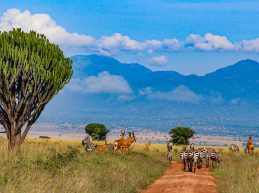

Straddling the equator and bisected by 13 rivers and numerous mountain-fed streams, Meru National Park is remote, rugged and prominently unspoilt national park in Kenya. The park rises on the broad northeastern slopes of Mount Kenya, in the Central Highlands of the country, straddling the equator at mile-high elevations.
Meru National Park is one of the least visited and least spoiled of Kenya’s national Park. Covering an area of 1810 sq km dominated mainly by bushland, grassland and thick forests along the park’s many watercourses. The park has 13 rivers and a myriad of mountain streams that feed into the Tana River. From the park, the towering Mount Kenya can be seen watching over this paradise.
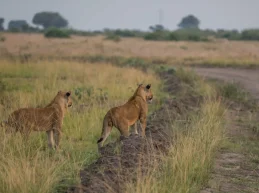
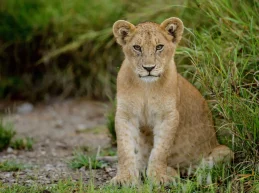
Meru National Park is famous for its role in the book and film Born Free. The park is the location of lioness Elsa’s release into the wild by Joy Adamson and her husband George. This is an old story worth re-visiting, good reading on a still and serene Meru afternoon graced with birdsong.
Climate in Meru National Park
The days are warm, rising to maximum of 30 deg C, but comfortable with minimum humidity, and the evenings are cool. Rainfall is mostly in April and May with an average of 350mm per year.
History of Meru National Park
Since 1966 when it was founded, Meru National Park has been a popular place for safari-goers in Kenya, boosted by the success of Born Free. Unfortunately its popularity plummeted during the 1980s and into the next decade, as the area was controlled by the poachers for many years. But all that was changed towards the turn of the century, as the International Fund for Animal Welfare, supported by the EU, determined to resto re Meru National Park to its former glory with assistance from the Kenya Wildlife Service. Roads were restored, rangers were re-employed, and a poacher proof rhino sanctuary was created. Meru National Park was reborn.
Wildlife in Meru National Park
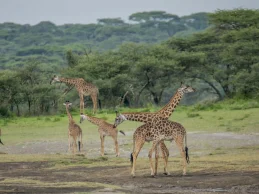
Meru National Park is a classic bush landscape supporting a healthy and varied population of wildlife including elephants, hippos, bushbigs, cheetahs, stately elands, common beise oryx, kirk’s dik-kis, lesser kudus, gerenuks, massive giraffes, hartebeests, Cape buffaloes and Grevy’s zebras among others.
Meru National Park has a 4,400 ha rhino sanctuary with 70 black and white.
Birdlife in Meru National Park
Meru National Park’s diverse habitats support over 400 species of birds recorded here, from wetland birds to grass and woodland species. These birds include African finfoot, Bat hawk, Black-faced sandgrouse, Boran cisticola, Buff-crested bustard, Crested guineafowl, Eastern chanting goshawk, Golden palm weaver, Golden-breasted starling, Hartlaub’s bustard, Hinde’s pied babbler, Lilac-breasted roller, Martial eagle, Namaqua dove, Northern pied babbler, Northern red-billed hornbill, Palm-nut vulture, Pel’s fishing-owl, Rosy-patched bush-shrike, Rufous chatterer, Saddle-billed stork, Somali bee-eater, Somali ostrich, Taita fiscal, Vulturine guineafowl, White-bellied go-away-bird, White-browed coucal, Yellow-necked spurfowl among others.
Meru National Park hosts 59 of the 94 Somalia – Masai biome species found in Kenya.
Things to do in Meru National Park
Game Viewing
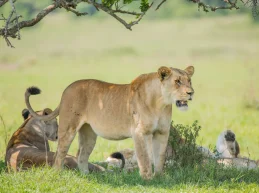
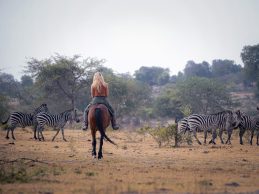
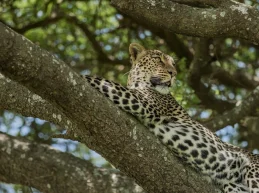
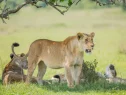
Meru National Park is home to a huge variety of wildlife including the Big Five, lion, leopard, rhinos, elephant and cape buffaloes. Other wildlife species like zebras and gazelles are known to roam free across much of the park, grazing on dry yellow tufts of grass.
The rivers around the park are also home to a lot of wildlife, within the murky depths, crocodiles lurk, waiting to pounce on any animal brave enough to approach these shores. Hippos are often seen sunbathing on the banks of the various rivers and lakes across the park.
Meru National Park has enormous diversity of habitat and wildlife, game drives will take you through forests, past giant baobab trees, through clear spring fed streams lined with palms. In addition to the big five, Meru has many rare species including caracal, the beautiful Lesser Kudu and aardwolf
Day Excursions to the Tana River
Take a picnic lunch and have a whole day to explore the sandy Tana River – Kenya’s longest. Rising in the highlands of Mt. Kenya and traveling 704 kms before emptying into the Indian Ocean.
Visit the Rhino Sanctuary
Meru National Park incorporates an 84 sq km rhino sanctuary, home to over 70 rhinos, both black and white rhinos. The size of the sanctuary ensures that finding the rhinos is a bit of a challenge.
Guided Nature Walks
Leave the vehicle and embark on an exploration on foot and enjoy the small things, tracks, dung beetles, naked mole rats and micro-ecosystems.
Enjoy a climb up to the very top of Mughwango Hill, enjoying a 360 degree view from snow-capped Mt. Kenya in the west to the vast Meru Plains to the east.
River Fishing
Take your road, afternoon tipple with some canapes and a good book, and settle on the palm lined banks of one of Meru’s many rivers. The fishing experience is fun, with plentiful catfish, tilapia and barbell. Share your prey with herons, monitor lizards and spectacular kingfishers.
Birding
With over 300 bird species, Meru National Park is a birding paradise offering some of the incredible bird sightings in Kenya. The park’s habitats host array of birdlife and some of the birds to lookout for include Golden-breasted starling, Hartlaub’s bustard, Hinde’s pied babbler, Lilac-breasted roller, Martial eagle, Namaqua dove, Northern pied babbler, Northern red-billed hornbill, Palm-nut vulture, Pel’s fishing-owl, Rosy-patched bush-shrike, Rufous chatterer, Saddle-billed stork, Somali bee-eater, Somali ostrich among others.
When to visit Meru National Park
Meru National Park is a year-round destination, however the dry seasons between June and September and December and March are the best time to visit this remote beautiful park.
During these months, weather conditions are perfect for game viewing, the visibility is excellent and rainfall won’t impede activities or accessibility to the park.
Where to stay in Meru National Park
There are several accommodation options in Meru National Park, ranging from budget, midrange to luxury. These include
- Elsa’s Kopje
- Rhino River Camp
- Ikweta Safari Camp
Getting to Meru National Park
You can get to Meru National Park on a one hour flight from Nairobi’s Wilson Airport to the park’s airstrip. By road, it is a drive of approximately 5-6 hours to Meru National Park from Nairobi City where most safaris start and end from.