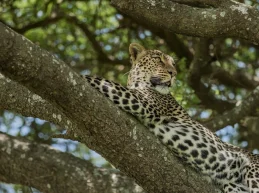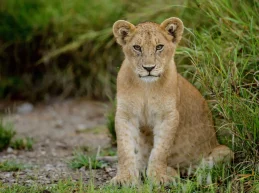

Home to the Great Migration, Serengeti National Park also known as The Serengeti is a World Heritage Site and the most popular safari destination in Africa teeming with abundant wildlife including over 2 million ungulates, 4000 lions, 550 cheetahs, 1,000 leopards and over 500 bird species inhabiting an expanse of approximately 14,763 square kilometres in size.
The iconic Great Migration is annual migration of millions of wildebeests thundering across the savannah, followed by hungry predators picking off the weak and young. Because thus annual migration, it is not hard to see why Serengeti National Park is among the most popular parks on the continent.
Serengeti National Park is situated in the northern region of Tanzania, forming a part of the vast Serengeti Ecosystem which stretches from the shores of Lake Eyasi in the south, encompassing the Maswa Game Reserve, the Ngorongoro Conservation Area and several other national park, stretching over to include Kenya’s Masai Mara National Reserve in the north.
Serengeti National Park is an enormous park with distinct regions, each offering a different safari experience. These regions include Northern Serengeti, Southern Serengeti, Central Serengeti, Eastern Serengeti and Western Serengeti.
History of Serengeti National Park
The beautiful history of Serengeti National Park is deeply intertwined with both conservation and human settlement. The name “Serengeti” comes from the Maasai word “Siringet” meaning “the place where the land runs on forever”. For centuries, the Maasai people have lived in harmony with the wildlife found in this area and their presence is still felt throughout the region.
In the early 20th Century, the Serengeti was the site of intense hunting and poaching. Recognising the need to protect the area’s unique wildlife, the British authorities declared the region a protected area in 1921. In 1951, Serengeti National Park was officially established, becoming one of the first national park in Tanzania and a model for wildlife conservation across Africa. Later, the park expanded to protect more the migration routes and surrounding ecosystems.
Due to its global significance and the conservation of endangered species such as the black rhinoceros and wild dog, Serengeti National Park was designated a UNESCO World Heritage Site in 1981.
Attractions in Serengeti National Park
The Great Migration
The Great Migration also known as Wildebeest Migration is one of the biggest draws in Serengeti, this annual migration is the world’s largest land-based migration comprising of over two million wildebeests, hundreds of thousands of zebras, and numerous antelope species. The annual migration is a continuous circuit followed by animals as they search for fresh grass provided by the rains.
Seeing this incredible natural event in person is an incredible experience like no other.
The migration is always moving, but there are defined periods when you can expect to find the animals in certain locations. From the late December through early March you can catch enormous herds in the Southern Serengeti and Ngorongoro Conservation Area, where the females give bird to the next generation. After the calving season, the herds move on towards the Serengeti’s western corridor, beginning around April. In June through October, the herds will congregate again as they attempt to cross both the Mara and Grumeti Rivers and make their way into the northern Serengeti and Kenya’s Masai Mara National Reserve. As the short rains in November and December set in, the herds will turn around and make their way south, completing the circuit when they reach the calving grounds of the Southern Serengeti once again around the start of the year.
Wildlife in Serengeti National Park
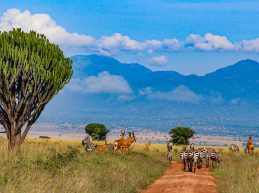
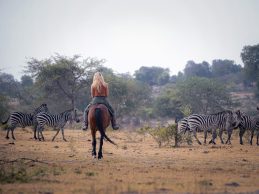
Serengeti National Park is one of the few places where you can witness all the Big Five animals living together in the wild. Unlike in the past, lions, leopards, rhinos, buffaloes and elephants are now more prized as wildlife photography subjects. These majestic creatures join the millions of wildebeests, gazelles and zebras that form the Great Migration which passes through the park each year.
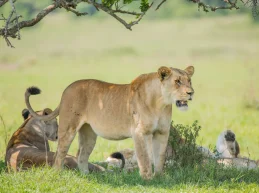
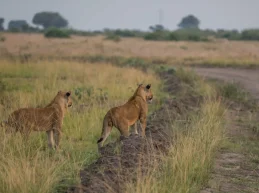
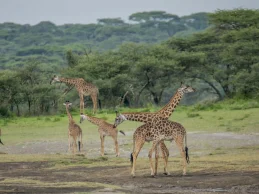
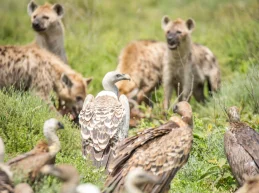
The Serengeti’s wildlife includes one of Africa’s largest populations of lions, around 3,000 in the Serengeti. Lion prides and predators such as cheetahs, leopards, and hyenas are all commonly spotted within the park. Other wildlife found in Serengeti National Park include giraffes, baboons, warthogs, hyraxes, honye badgers, African golden wolves, crested porcupines, aardwolves, and bat-eared foxes, topis, waterbucks among others.
Birdlife in Serengeti National Park
Serengeti National Park is home to 500 bird species making the park an exciting destination for avid birds, these birds thrive in the various vegetation zone in the park including grasslands, woodlands and forest galleries.
Bird species found in Serengeti National Park include Black-headed gonolek, Fischer’s lovebird, Green-backed woodpecker, Grey-backed fiscal, Grey-breasted spurfowl, Grey-crested helmet-shrike, Hildebrandt’s starling, Red-capped robin-chat, Rufous-tailed weaver, Rüppell’s vulture, Schalow’s turaco, Silverbird, Southern ground hornbill, Usambiro barbet, Verreaux’s eagle and Yellow-throated sandgrouse among others
Safari Activities To Do in Serengeti National Park
Game Dives
Game viewing is the most sought after safari activities in Serengeti National Park. The park is home to a diverse array of wildlife including the Big Five (lion, leopard, cape buffalo, elephants and rhinos) and the Great Wildebeest Migration.
Game viewing in Serengeti National Park is done on morning and afternoon game drives or full day game drives, on this thrilling experience expect to encounter several animals including lions, leopards, buffaloes, elephants, warthogs, wildebeests, gazelles, zebras, hyraxz, giraffes, cheetahs and wild dogs among others.
Hot Air Balloon Safari
Hot air balloon safari is one of the most popular Serengeti Safari activities, nothing really comes close to get a truly Out of African Experience by soaring up the sky in a balloon ride over the Serengeti, and especially during the Great Migration. Float gently and silently over the treetops going where the wind takes you.
Enjoy a bird’s eye view of the Serengeti’s endless plains and animals. Balloon Ride is a perfect Serengeti Safari experience to take amazing photos of wildlife most especially during The Great Migration.
Maasai Boma Visit
Experience a traditional Maasai Boma and see and experience their fascinating way of life. Experience what it is like to live in one of their homes, what their homes are actually made of, what they eat and enjoy a welcome dance with their amazing vocal codes.
You may watch or take part in the traditional dance and you are welcome to take amazing pictures while in the Boma.
Bird Watching
Serengeti National Park is a paradise for bird enthusiasts, offering a chance to see over 500 bird species. The park’s varied landscapes from open savannahs to riverine forests and wetlands support a wide range of birdlife, making bird watching in Serengeti a truly rewarding experience.
Serengeti is home to several endangered and migratory bird species that travel thousands of kilometres to reach these fertile grounds. The Kori bustard, the world’s heaviest flying bird is one of the most notable species in Serengeti which can be found striding through the open plains. Other bird species to lookout for in Serengeti include Secretary bird, white stork, European roller, Lilac-breasted roller, Superb Starling, herons, flamingos, pelicans among others.
Best Time to Visit Serengeti National Park
The best to visit Serengeti National Park for a safari is in the dry season (from late June to October). The period offers the most incredible game viewing experiences, with the wildebeest migration as its absolute highlight.
However, wildlife viewing in Serengeti is good throughout the year. For visitors interested in witnessing the Migration, keep in mind that the timing varies annually, with the best chance of witnessing the epic animal migration around June to July. You can witness the wildebeest calving in late January to February.
Where to stay in Serengeti National Park
There are several accommodation options around the several regions of Serengeti National Park ranging from budget, midrange to luxury. Our best options include Grumeti River Camp, Four Seasons Safari Lodge, Singita Faru Faru River Lodge, Klein’s Camp, Singita Mara River Camp, Olakira Migration Camp, Sabora Luxury Tented Camp, Sasakwa Lodge, Serengeti Migration Camp, Serengeti Serena Safari Lodge among others.
How to Get to Serengeti National Park
Serengeti National Park is situated an eight-hour drive (325 km/202 miles) from Arusha, from here you can get to the park either by air or road.
By road – Serengeti National Park is accessed using four main entry and exit points – Naabi Hill Gate, Ndabaka Gate, Klein’s Gate and Bologanya Gate. From Arusha Town, it is a drive of approximately 6 hours in a safari vehicle with a transit through Ngorongoro Crater.
By Air – there are domestic flights from Arusha Airport in Arusha to one of the airstrips serving Serengeti National Park. From Arusha Airport it will take approximately 1.5 hours to fly one of the seven airstrips, these flights are operated by local airlines such as Grumeti Air or Coastal Aviation among others.